The population of southeast Texas had been increasing since the late 1800s, and it exploded after the discovery of oil at Spindletop and elsewhere in the area. Southeast Texas attracted workers and technologists and hucksters as well for decades to come. But who were the folks coming to old Tsayon Né, in the early twentieth century? Faceless mobs? Mere statistics? Lillie Ann offers an illuminating example and puts a face on those coming to the region in the early twentieth century.
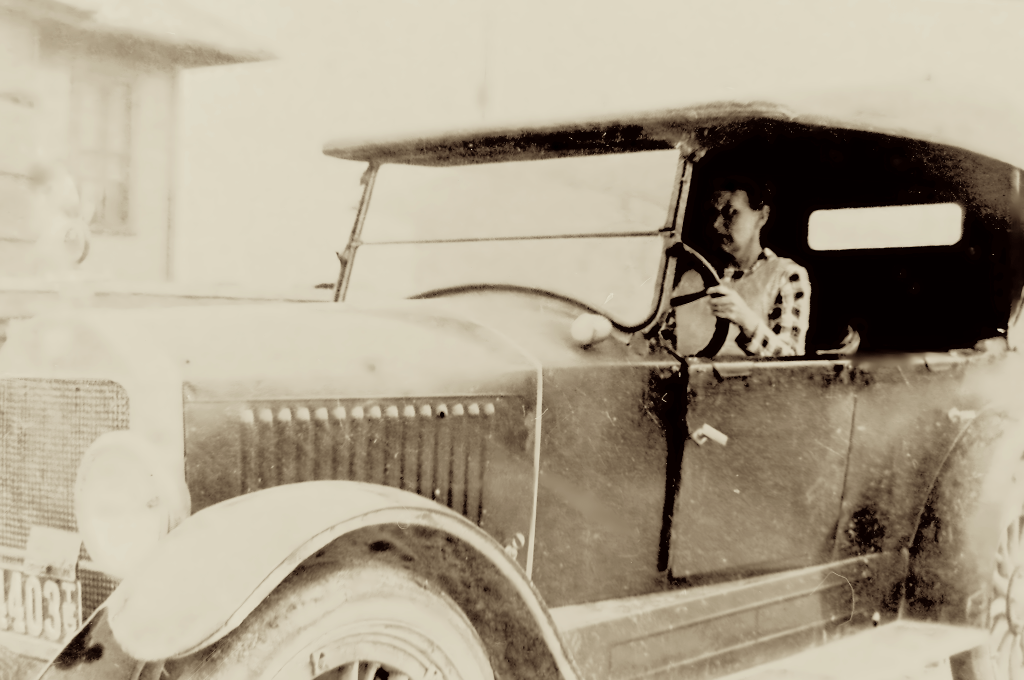
Lillie Ann Campbell in the car she used at her boarding house in Guffey.
Lillie Ann Sullivan had been born in rural Cannon County Tennessee, east and south of Nashville, in 1874, nine years after the end of the US Civil War. She had been born to James Thomas Sullivan and Nancy Elizabeth McBroom, and Lillie was joined by a sister Margaret (“Maggie”) in 1877. Her father was a farmer who represented the old agricultural economy of central Tennessee.
Lillie married James Allen Campbell in 1898. James had been educated at the Woodbury “College,” which later came to be called Woodbury High School. His report cards show he made high marks. He had been a schoolteacher since 1895, but his salary was limited and he took other jobs on the side, like contracting to build a stone fence. Their first child Elam Campbell was born in 1898 and a second son James (Jimmy) was born in 1900.
They heard about the excitement in southeast Texas! In fact, Lillie Ann’s sister Maggie had moved to Nederland, Texas, with her husband Hiram Stroud. James and Lillie followed Maggie and Hiram to Nederland with little Elam and Jimmy two years after the Spindletop gusher came in, and they all lived with Maggie and Hiram Stroud between January 1903 and May of that year when they decided to return to Tennessee. We do not know why they returned; perhaps it was simply the fact that their family’s roots for generations were in Tennessee.
After they returned to Tennessee, James began working for the Carter shoe factory in Nashville, where their third son John (Johnny) was born in 1904. The family apparently lived back and forth between Nashville and Cannon County until the July 6, 1906, when James died unexpectedly in Nashville.
James’s death left Lillie Ann widowed at the age of 32 with three sons, aged 8, 6, and 2, and with little or no financial resources. One sign of their poverty: they could not afford a permanent grave marker for James. And then Lillie’s father James Sullivan also died in 1906, another blow. What was she to do? Lillie Ann made a tough decision to return to Texas where she had seen opportunities. She brought her boys to Hill County, Texas, where they stayed with Lillie’s McBroom relatives for a while, and then they all moved to Beaumont.
In fact, they moved to the Guffey community adjacent to Spindletop: a shanty town in the midst of a hive of oil wells. Lillie managed a boarding house in Guffey and her three boys grew up in the oil fields of southeastern Texas. They attended South Park High School, but they had no time for football or other school activities: they had to be with Lillie managing the boarding house next to the railroad tracks in Guffey.
Lillie’s mother Nancy Sullivan had come to live with her in Texas, and they raised vegetables next to the boarding house and made quilts on the side. It was a tough life, but by 1930 Lillie had managed to buy a home for her family on Shell Street in South Park, just a couple of blocks from where Anthony Lucas had lived with his family on Highland Avenue in 1901. She raised her boys in the South Park Church of Christ, and all three boys spent their careers in the oil business: Johnny worked for the Gulf Oil Company all his career. Elam became a manager for Yount-Lee Oil Company and its successors and traveled throughout southwestern Louisiana and southeast Texas in that capacity.
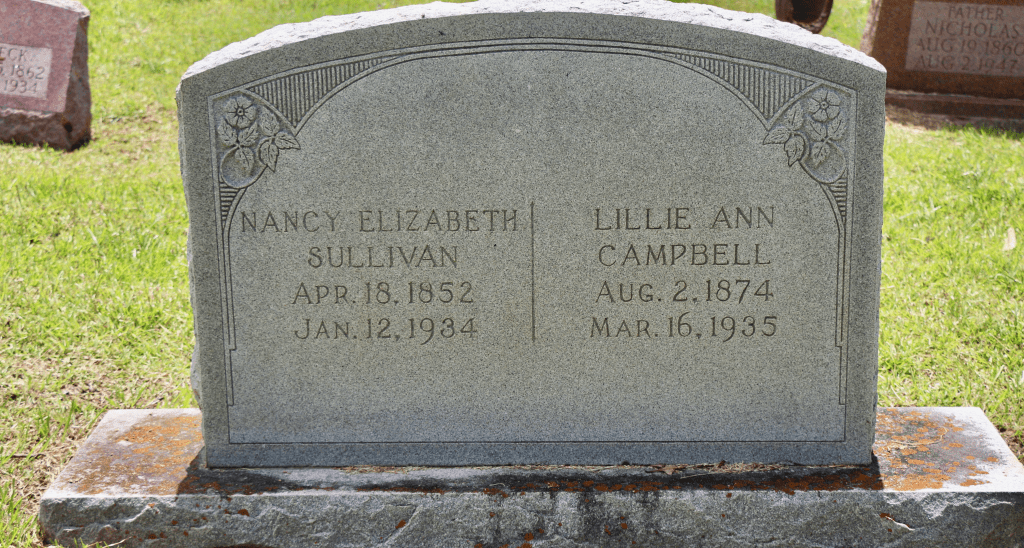
Graves of Nancy Elizabeth Sullivan
and Lillie Ann Campbell, Magnolia Cemetery, Beaumont.
Lillie’s mother Maggie Sullivan died in 1934 and Lillie died in 1935. They are buried next to each other in Magnolia Cemetery in Beaumont. Lillie’s youngest son Jimmy died in Winnie, Texas, in the early 1950s. I never met him or Lillie or Mrs Sullivan. Lillie Ann was my great grandmother, and although I never met her, I knew Johnny and Elam very well: Elam was my grandfather, and when my Uncle Johnny died in 1976, still living in the home on Shell Street that Lillie Ann had bought, I as a very young minister presided at his funeral and his burial in Magnolia Cemetery near his mother and his grandmother Sullivan.
Lillie and her mother and her sons put faces and stories on some of the the crowds of people moving to southeast Texas in the early twentieth century. They and others moving there were neither faceless nor nameless nor un-storied. Like Lillie and her boys, they had faces and stories and most of them brought their families with them. Learn their stories and remember them.
+ REMEMBER LILLIE ANN BEFORE GOD +
 Tsayon Né