Tsayon Né is my blog about southeastern Texas history. Tsayon Né, pronounced something like t-sigh-own nay is what the Atakapa people of southwestern Louisiana called the land on the other side of the Sabine River, that is, “Texas,” but with special reference to southeastern Texas. You can read more about this name here.
What’s “southeastern Texas”? For this project, I mean the area between the Sabine and San Jacinto rivers, and between the Gulf coast and the rolling hills of East Texas. Roughly. More than the “Golden Triangle.”
The Neches is a mighty river in southeastern Texas, but it begins with four little headwater streams on the prairie in Van Zandt County, just south of Colfax, Texas. I visited the area on Sunday July 7, 2024, and made some drone video following two of these streams that you can see in the picture below. The family that owns this land say there are two more streams that flow into the river just beyond where these streams converge.
Two Headwater Streams of the Neches River in Van Zandt County
At this point, the little streams are flowing to the northeast, but they turn east very quickly and flow into Rhine Lake, and from there the river flows basically southeast to Port Neches, beyond which the Neches and the Sabine rivers flow together into Sabine Lake. It’s 416 mikes from the little streams you see here to Sabine Lake.
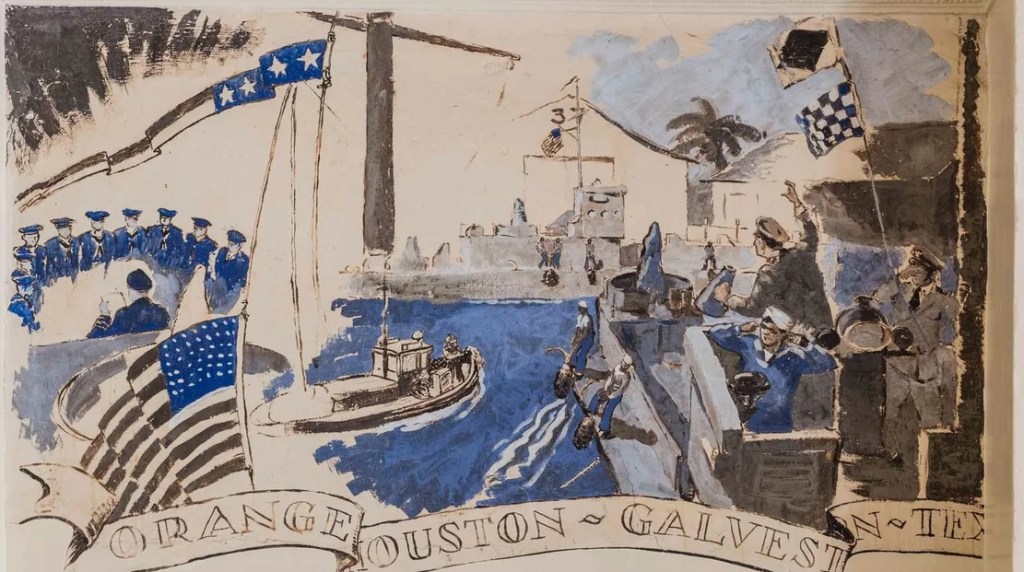
My wife Dale and I vacationed in Torquay on “the English Riviera” (hmmm…) in the summer of 2019. We took a trip out to see Greenway House, the home of English crime writer Agatha Christie and we found on the wall of her library this depiction of the shipyards in Orange, Texas.
Why? Greenway House overlooking Torbay had been acquisitioned as a lodging for officers in the months leading up to the D-Day invasion in June 1944. Officers of the 10th U.S. Coast Guard flotilla headquartered in Torbay used the house and one of them painted (or hired someone to point) a series of linked images (friezes) on the upper walls depicting the wartime efforts of their flotilla.
The friezes in the library begin with this image depicting the construction of their ships in Orange, Texas, and the initial—and apparently disastrous—trials of the ships in Galveston Bay. This image depicts an officer with arms raised screaming at ships’ crews!
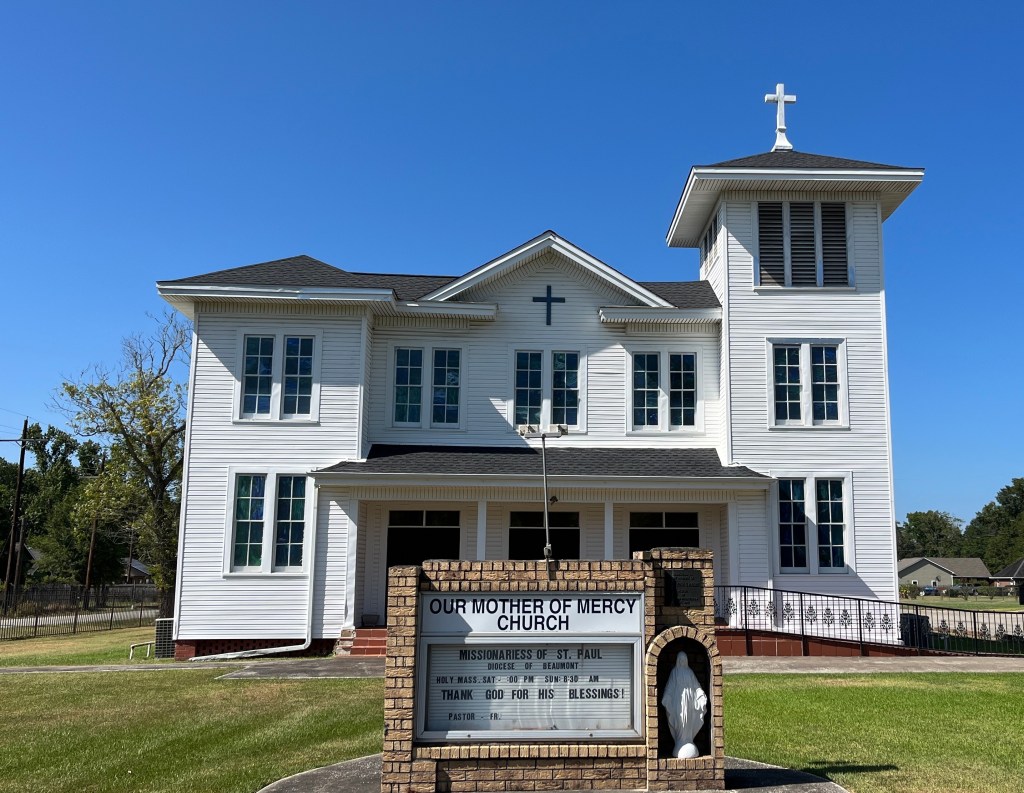
The town of Ames, Texas, just east of Liberty Texas, had been established just after the US Civil War and was a rail stop on the Texas and New Orleans Railroad between Beaumont and Houston. In 1890 Black and Creole settlers from St Mary’s Parish Louisiana led by Sylvester Sostan Wickliff moved to Ames. They joined the existing rice-farming community in Ames and established a Catholic Church there in 1897 that has become Our Mother of Mercy Catholic Church.
When I’m taking drone video I’m too focused on whether the drone is going to hit a tree or a highway to pay attention to anything else. So I examined my video of a pond in the Trinity River Waterfowl Rookery in Wallisville, and look what I found. The alligator is thrashing a fish. Big. Fish. Maybe a gar?
The population of southeast Texas had been increasing since the late 1800s, and it exploded after the discovery of oil at Spindletop and elsewhere in the area. Southeast Texas attracted workers and technologists and hucksters as well for decades to come. But who were the folks coming to old Tsayon Né, in the early twentieth century? Faceless mobs? Mere statistics? Lillie Ann offers an illuminating example and puts a face on those coming to the region in the early twentieth century.
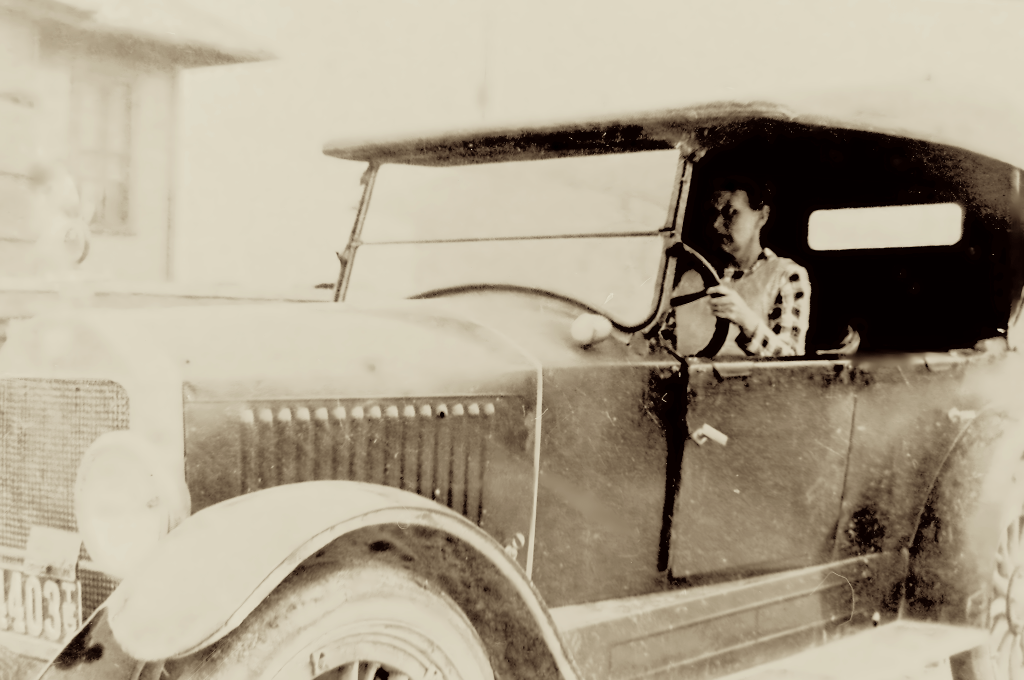
Lillie Ann Campbell in the car she used at her boarding house in Guffey.
Lillie Ann Sullivan had been born in rural Cannon County Tennessee, east and south of Nashville, in 1874, nine years after the end of the US Civil War. She had been born to James Thomas Sullivan and Nancy Elizabeth McBroom, and Lillie was joined by a sister Margaret (“Maggie”) in 1877. Her father was a farmer who represented the old agricultural economy of central Tennessee.
Lillie married James Allen Campbell in 1898. James had been educated at the Woodbury “College,” which later came to be called Woodbury High School. His report cards show he made high marks. He had been a schoolteacher since 1895, but his salary was limited and he took other jobs on the side, like contracting to build a stone fence. Their first child Elam Campbell was born in 1898 and a second son James (Jimmy) was born in 1900.
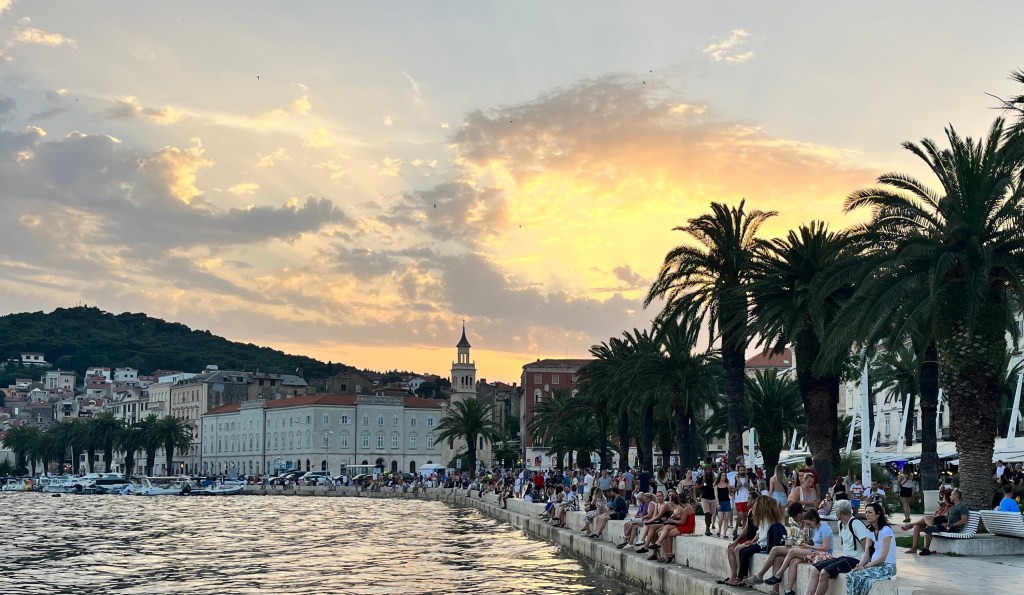
Contemporary photo of Split (Spalato), Croatia, birthplace of Antun Lučić (photo by Annette Jensen, 2023)
Southeastern Texas folks are familiar with the name of Anthony Lucas, the engineer behind the Spindletop oil gusher of January 1901. Lucas Elementary School and Lucas Drive in Beaumont are named for him. He lived in southeastern Texas only for a few years, but he hugely influenced the region and the petroleum industry throughout the world. Ellen Walker Rienstra, Judith Walker Linsley, and Jo Ann Stiles, who wrote the definitive history of the Spindletop oil discovery Giant Under the Hill (2008) describe Lučić as “cosmopolitan,” and he was indeed. He contributed deeply to the increasingly cosmopolitan character of southeastern Texas in this age.
Antun Lučić (pronounced like Loocheech) grew up on the eastern shores of the Adriatic Sea, a northern extension of the Mediterranean Sea with Italy along its western shore, Venice at its northern end, and the Balkan Peninsula along its eastern shore. Along the Baltic coast of the Adriatic Sea were Montenegro, a series of Slavic-speaking countries including Croatia and Serbia, and then Greece at its southern end.
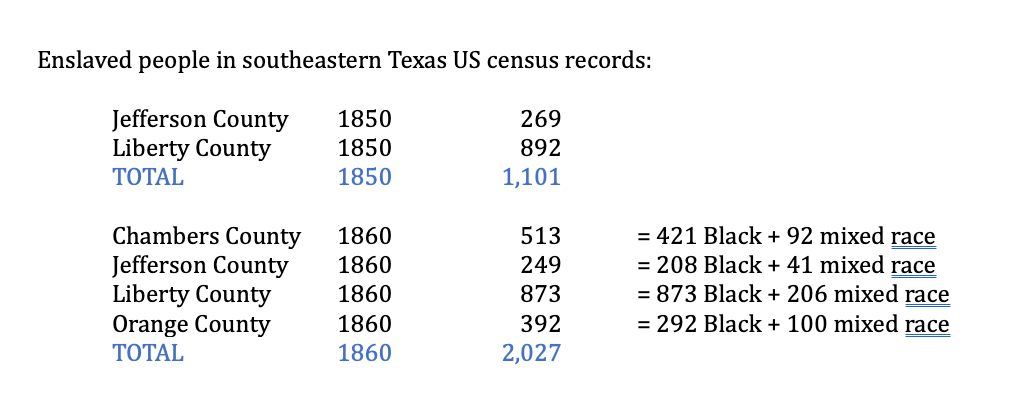
I describe southeastern Texas – for this project – as including Jefferson, Orange, Chambers, and Liberty counties. In 1850 at the time of the first US census for Texas, only Jefferson and Liberty counties existed. But I find a big anomaly between numbers of enslaved people in Jefferson and Liberty counties in 1850 and then in 1860, the last US census showing enslaved people.
The 1850 US census showed 269 enslaved people in Jefferson County. In the same year, the census for Liberty County showed almost three times as many enslaved people, 892 total.
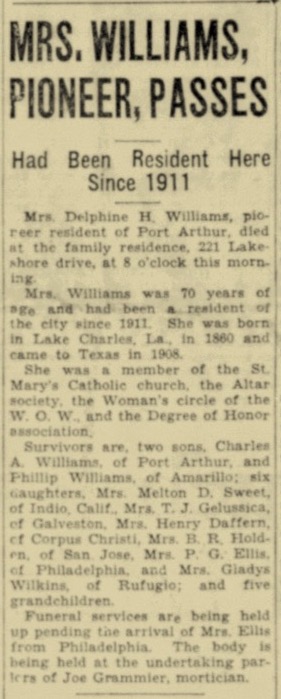
Say a prayer as you drive by Calvary Cemetery in the messy triangular intersections of Ninth Avenue and Twenty-Fifth Street and Lombardy Drive in Port Arthur. Buried there in an unmarked grave alongside hundreds of other Catholic folks is Delphine Huntington Williams (1860-1930).
Delphine died on August 7, 1930. An obituary on the front page of the Port Arthur News celebrated her as a pioneer citizen of the city, a mother of eight children, and a member of the altar society of St Mary’s Catholic Church. Fifteen years later, the morning after the US detonated an atomic bomb over Hiroshima, the Port Arthur News carried a column headed “15 Years Ago Today…” It said: “Mrs. Delphine H. Williams, pioneer Port Arthur resident, died at her home, 221 Lakeshore drive.”
She was indeed a pioneer Port Arthur resident, and I’m sure she was a faithful mother and a member of the altar society at St Mary’s. But Delphine Williams carried an important secret to the grave with her. Few could have known.

 Tsayon Né