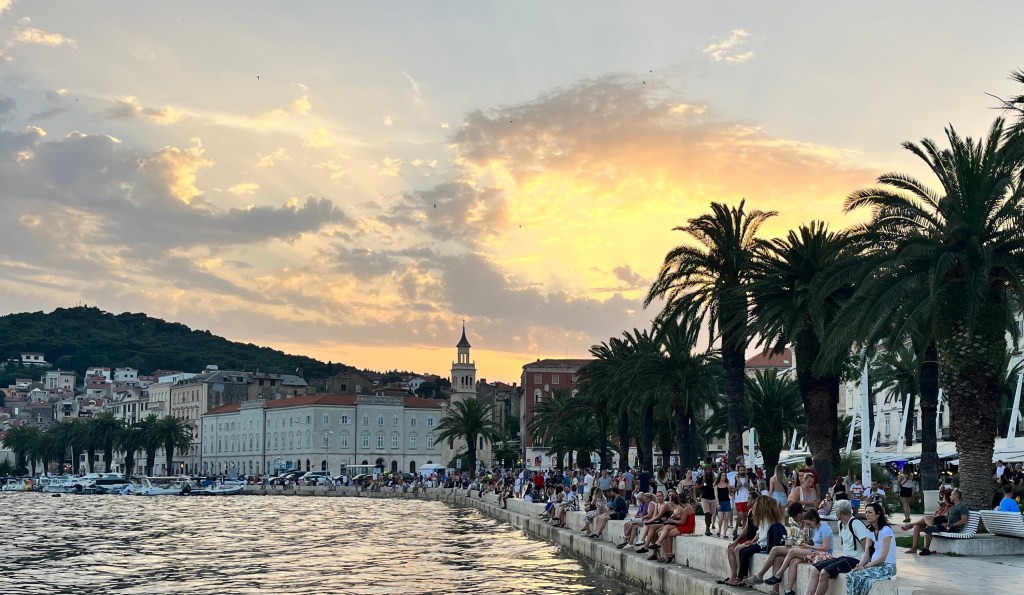
Contemporary photo of Split (Spalato), Croatia,
birthplace of Antun Lučić (photo by Annette Jensen, 2023)
Southeastern Texas folks are familiar with the name of Anthony Lucas, the engineer behind the Spindletop oil gusher of January 1901. Lucas Elementary School and Lucas Drive in Beaumont are named for him. He lived in southeastern Texas only for a few years, but he hugely influenced the region and the petroleum industry throughout the world. Ellen Walker Rienstra, Judith Walker Linsley, and Jo Ann Stiles, who wrote the definitive history of the Spindletop oil discovery Giant Under the Hill (2008) describe Lučić as “cosmopolitan,” and he was indeed. He contributed deeply to the increasingly cosmopolitan character of southeastern Texas in this age.
Antun Lučić (pronounced like Loocheech) grew up on the eastern shores of the Adriatic Sea, a northern extension of the Mediterranean Sea with Italy along its western shore, Venice at its northern end, and the Balkan Peninsula along its eastern shore. Along the Baltic coast of the Adriatic Sea were Montenegro, a series of Slavic-speaking countries including Croatia and Serbia, and then Greece at its southern end.
Antun was born in 1855 in the coastal Croatian city of Split (Spalato), now a Mediterranean resort city (see photo above). The ancestors of his prosperous family were from Montenegro. His father was a shipbuilder and ship owner. Antun was baptized as Antonio Francesco reflecting the Montenegrin and Italian aspect of his family’s Balkan heritage.
In his time, Croatia was part of the Austrian Empire, and Antun attended a prominent Technical Institute in Graz, Austria. One of his fellow Balkan students at the Institute was Nikola Tesla who would pioneer electrical technologies. Lučić and Tesla had entered the Institute in an era of huge optimism in Europe in the late 1800s, an optimism grounded in emerging technologies like mining and electricity. Europeans believed that new technologies would inevitably be used to build a better world for all people. That vision would be crushed by the technologically enabled atrocities of World War I in Europe, but Lučić and Tesla were formed early in life by the vision of technological progress.
After completing his technological training, Lučić was given a commission as a lieutenant in the Austrian Navy, and he would be called “Captain” through his life, though he demurred from the title. In 1879 he visited relatives in Michigan and decided to settle in the United States, calling himself Anthony Francis Lucas in English. He married Georgia native Caroline FitzGerald in 1887. They had one child, Anthony FitzGerald Lucas, and they moved to Washington DC in 1889 where they would stay for the remainder of their lives except for brief stays as a family in areas where Anthony worked, including a short but crucial period in Beaumont, Texas, at the very end of the 1800s and the beginning of the 1900s.
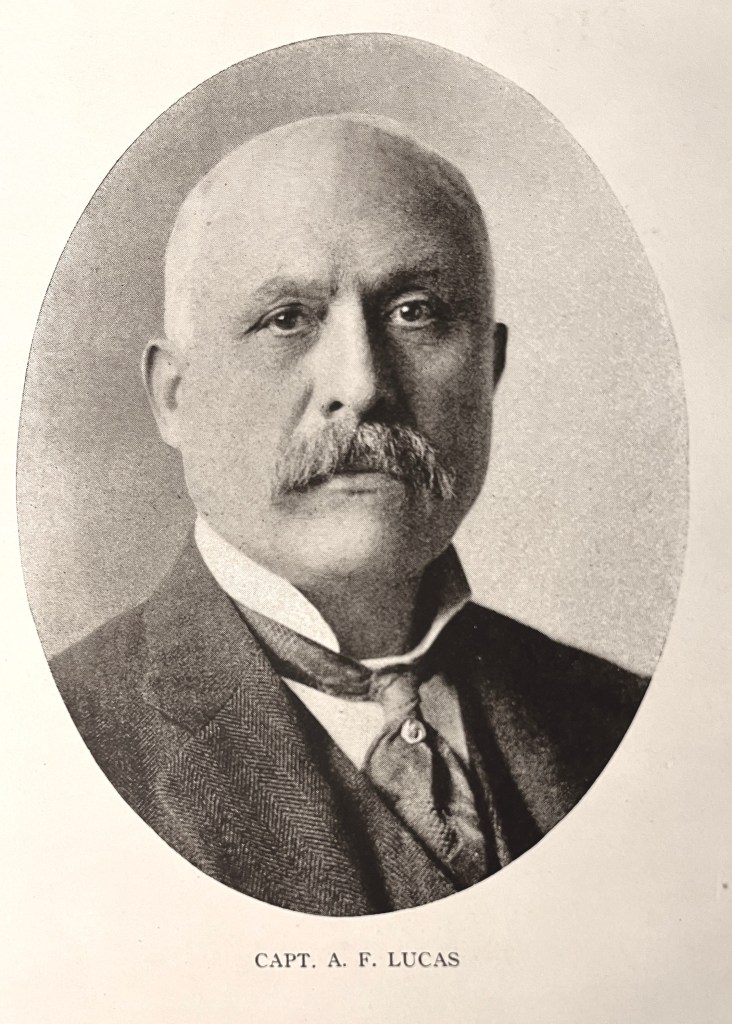
Lucas’s expertise was in mining, and he had worked in salt mines at Avery Island, Louisiana, then in the sulfur mining industry in Sulphur, Louisiana. While in the area of Avery Island, Anthony began to notice a consistent correlation between salt dome formations and the presence of crude oil. Lucas took up this correlation between salt domes and underlying crude oil as a passionate focus, and that led him to southeastern Texas.
Lucas made several visits to southeastern Texas in the 1890s, but he became particularly interested in the salt-dome formation called Spindletop that Patillo Higgins had already identified. He was so interested that he moved his wife Caroline and son Anthony Jr to Beaumont, where they took a modest home on Highland Avenue for a few years. Self-taught Higgins and formally educated Lucas were both convinced of the potential of the site. They contracted with the Hamill brothers of Corsicana to bring drilling expertise and gear. Both Higgins and Lucas were strapped for cash at this point, and they also spent time raising funds for the drilling enterprise. Lucas gave up most of his own financial interest in the site to fund the drilling.
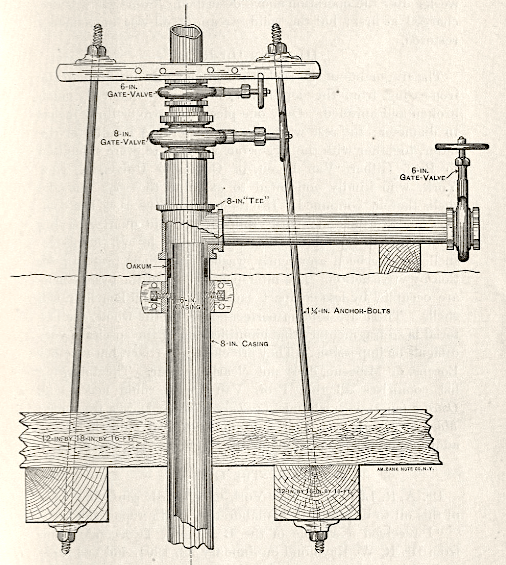
Lucas’s device for closing the blowout of the Spindletop well
(from Reid Sayers McBeth, Pioneering the Gulf Coast [1918], p. 5).
The immediate problem that Lucas, Higgins, the Hamill brothers, and their financial supporters faced was the uncontrolled flow of the well. If it remained unstopped, the well would be regarded as useless and dangerous. Lucas delivered a technically documented report in the next month (February 1901) in which he explained how the well was controlled. Although he was flooded by telegraphs offering unproven services for closing the well, Lucas was the engineer and he quickly devised and built a capping mechanism involving cascading sections of 8” and 6” pipe with separate valves to close off the flow to each, and with a horizontal outflow pipe. A foundation was laid in the ground while the oil continued to blow out. Then on the morning of January 19, workers moved Lucas’s closure device into place, carefully maneuvering it so that eventually the flow of oil passed through it. Workers then anchored the device with bolts to the foundation they had secured, and the valves were closed in a sequence that brought the flow to a standstill. By the afternoon of January 19, Lucas and Patillo and their supporters not only had an oil well with huge capacity: they also had a well that could be controlled. The control part of it was Anthony Lucas’s particular technical genius.
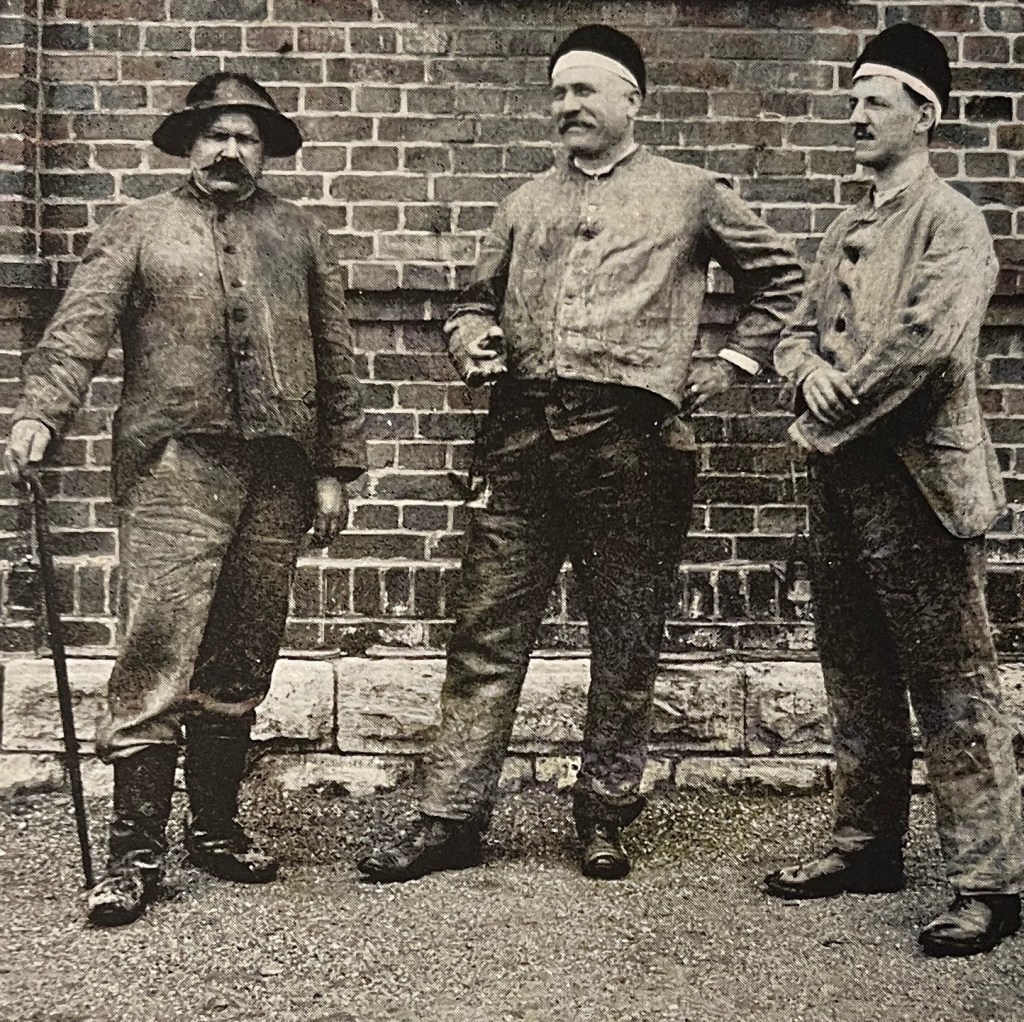
Lučić (center) preparing to visit the Strassfurt potash salt mines in Germany
(from Reid Sayers McBeth, Pioneering the Gulf Coast [1918], opposite p. 53).
Lucas didn’t make much money from the Spindletop well, but he gained international attention as the expert in emerging petroleum technology. He and Caroline and their son moved from Beaumont back to Washington DC within a year or two, and remained there for the rest of their lives. Anthony Lucas traveled internationally to view and advise producers of mines and petroleum production facilities. He died in 1921 and the inscription on his tomb in Rock Creek Cemetery notes that he was born “of Illyrian Parentage” in “Spalato, Dalmatia,” using the ancient Roman designations for the regions of his birth and of his family. Antun Lučić was a cosmopolitan indeed.
+ REMEMBER ANTHONY FRANCIS BEFORE GOD +
 Tsayon Né