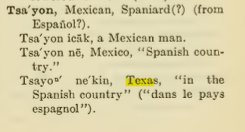
Entry in Gatschet and Swanton, Atakapa Dictionary for the word Tsayon including the the phrase Tsayon né.
The Atakapa people of southwestern Louisiana used the phrase Tsayon Né to denote the land across the Sabine River: “Spanish Land.” It denoted Spanish North America before 1821. It denoted Mexico from 1821 until 1836, and it denoted Texas from 1836. But when the Atakapa people in Calcasieu Parish, Louisiana, said Tsayon Né, it meant the part of Texas they found right across the Sabine River: what we call southeastern Texas today.
Smithsonian ethnographer Albert Gatschet recorded in 1885 the native words that two women Kishyúts (Luison Bonin Huntington) and Tóttoksh (Delilah Moss) used to describe the land to the west of Calcasieu Parish: Tsayon Né.
The word né means “land.”
A contemporary scholar of the Yukhíti (Atakapa) language explains that the word Tsayon was derived from the Caddoan (Native American) word Hispayun, which was derived from the Spanish word Español denoting “Spanish” land and so Tsayon Né described the “Spanish land” to the west of what’s now Louisiana, land that became Mexico and Texas.
To honor its native people and to offer a different perspective on the area, I will call southeastern Texas by the native name Tsayon Né.
The complicated interweaving of languages and cultures in one phrase makes Tsayon Né an appropriate reminder of the deep history of southeastern Texas. This region was a borderland between the coastal prairies and the piney woods to the north, a borderland between coastal native peoples like the Atakapa and the piney-woods natives of the Caddo confederacy. Tsayon Né became a no-man’s-land between Spanish and French colonists in North America. It remains a murky frontier between the US South and the US Southwest today.
Sources:
On the Yukhíti (Atakapa) phrase Tsayon Né: Geoffrey Kimball, Yukhíti Koy: A Reference Grammar of the Atakapa Language (Lincoln: University of Nebraska Press, 2022), p. 240 s.v. “cayon” (Kimball uses a newer symbol “c” for the earlier phoneme symbol “ts” that I have preferred here since “ts” does sound more like our pronunciation of the native letter) and p. 255 s.v. “né.” I’m grateful for personal correspondence with Dr Kimball about the meaning of this phrase. His work is based on the Atakapa Dictionary (Washington, D.C.: Smithsonian Institution; Bureau of American Ethnology bulletin 108, 1932) compiled by Albert S. Gatschet and John R. Swanton based on linguistic materials supplied to them by ten speakers of the Atakapa language including Louison Bonin/Huntington (Kishyuts, the mother of Delphine Williams) and (Delilah Moss (Tóttoksh).
 Tsayon Né