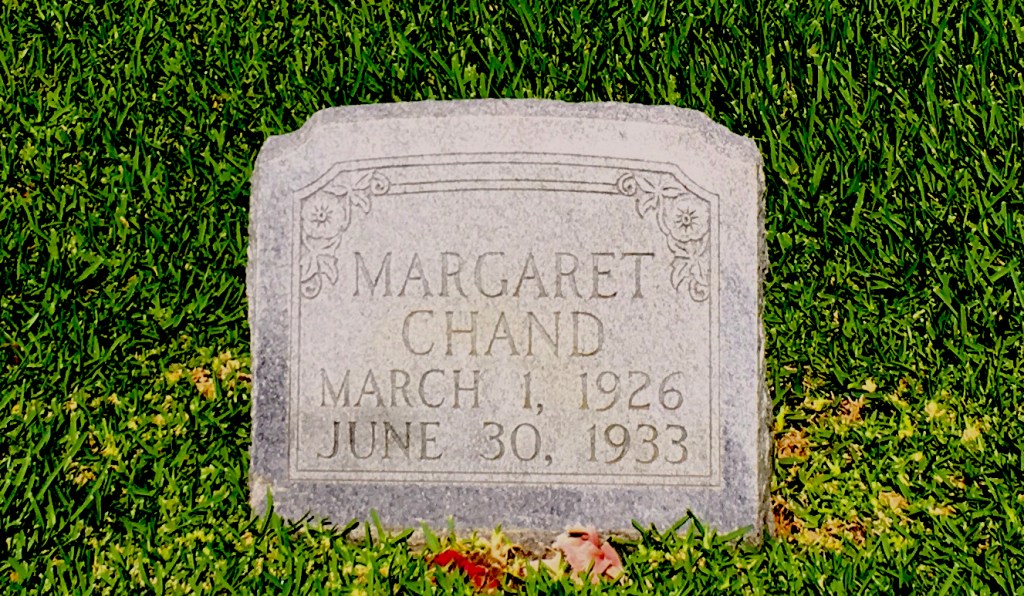
Grave of Margaret Chand in the Spell Cemetery, Rosedale (Beaumont)
There’s a sad little gravestone in the Spell Cemetery in Rosedale on the north side of Beaumont. “Look at this,” I said to my mother.
“O Margaret!” mom said, and then with her voice breaking a bit, “She was my friend.”
Both of my parents were born in Rosedale in 1926, the same year as Margaret. Margaret was a schoolmate of my mother in the Voth-Rosedale School. She had walked with two younger brothers on a hot summer day to the Treadway Canal that watered the rice farms. Margaret bent down on a rail bridge to get a drink of water from the canal and slipped. One brother grabbed her clothes, but she fell into the canal and drowned. She was six years old.
Who was Margaret Chand? Follow the track of public documents, and they tell a consistent story: Margaret’s father Mehar Chand had been born on May 18, 1894, in the town of Mahilpur in the Hoshiarpur district within the Indian state of Punjab. Mahilpur was on a plain famous for its mangoes, and from its mango groves the Himalayas could be seen rising 80 kilometers to the northeast. Mehar had grown up under the British imperial government of India, the Raj, with his father Nathu Ram Chand and his mother Ganga Devi, who died in 1911 when Mehar was seventeen years old.
Soon after his mother’s death, Mehar left Mahilpur and traveled by way of Mumbai to Cuba and from there to Florida, arriving in Tampa on November 2, 1913, on board the USS Olivette. The ship’s manifest showed his occupation as “student.” He soon acquired the title “Pandit,” denoting a person trained in a field of expertise. That title would be listed as his first name in English-language documents. Pandit Mehar Chand also studied in England at some point, but he came to southeastern Texas some time after he landed in Florida: he married Eulalia María Torres in Beaumont in early 1919.
Eulalia was the oldest child of Atenógenes and María (née Morales) Torres, natives of a village called Torreón in Coahuila who had come into Texas just two months after Eulalia’s birth in Coahuila: tough traveling through a war-torn land for a new mother. They would have been eager to leave Mexico: in fact, Eulalia’s pregnancy was likely the only reason they waited until early in 1912, for in the early years of the Mexican Revolution, warring generals were raising armies around the country, destroying cities and forcing populations to leave in increasing numbers.
Atenógenes and María left with their baby Eulalia. After arriving in Texas, they came to be known as Gene and Mary, and settled early in Orange County, Texas, where their second child Carmen was born in 1908. By the time Pandit Mehar Chand arrived in Beaumont, Gene and Mary Torres and their growing family including daughter Eulalia Maria had moved there. Punjab meets Coahuila in Beaumont.
Pandit Mehar Chand was known as a lecturer, perhaps in business-related subjects. In 1920 was shown as managing a lumberyard in Beaumont. By 1930 he owned his own business as a fruit merchant (mangoes?). City directories showed him as owning a grocery store that employed at least one of his brothers-in-law, John (Juan) Torres.
Pandit Mehar Chand and his wife Lula, as the family called their mother, eventually had fifteen children who graced the pages of the Beaumont High School Pine Burr annual, and who were fruitful and multiplied and had scads of grandchildren, many of them still in southeastern Texas. One of their grandchildren, Margaret’s nephew, is now a professor of immigration studies at Kent State University in Ohio. Mehar died in 1977; Lula a decade later.
But of course, little Margaret didn’t make it to the second grade: an immense tragedy for her family; a tragedy in my mother’s memory.
But a child can tell us something about the history of a place: Margaret Chand represents the intersection of immigrants coming to southeast Texas in this time: a complicated immigrant story in which an immigrant from the British Raj in India met an immigrant from war-torn Mexico in the age of its revolution.
I ask you to remember Margaret Chand before God. Her short life was a sign of the of the complicated humanity of the place I call Tsayon Né in the early twentieth century.
 Tsayon Né